
Slewing Ring Bearings for Cranes and Excavators

Why the slewing ring matters
Every time a crane swings a load or an excavator turns to dump a bucket, one bearing carries the entire upper structure. That part is the slewing ring bearing, also called a swing bearing or turntable bearing. It connects the rotating upper structure to the undercarriage or base, and lets the machine turn while carrying the weight and the overturning forces.
A failing slewing ring is expensive. It is one of the largest single parts on the machine, replacing it means lifting off the whole upper structure, and the machine is out of work until the job is done. Spotting wear early, and choosing the right bearing when the time comes, saves both money and downtime.
This guide explains how slewing rings work, which types suit cranes and excavators, how to select one, and how to inspect and maintain it.
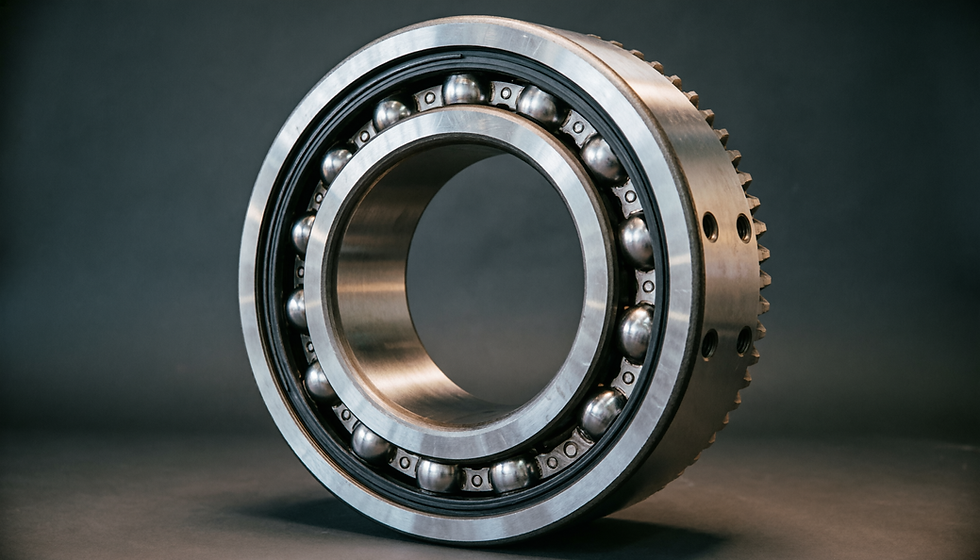
How a slewing ring bearing works
A slewing ring is a large bearing made of two rings, with balls or rollers running between them. One ring bolts to the upper structure and the other to the undercarriage or crane base. Most also carry a gear, cut into the inner or outer ring, that meshes with a pinion on the swing drive to turn the machine.
Sizes range from about 300 mm to 6 m in diameter, and some exceed 20 m (Cranes Today). Unlike a shaft bearing, a slewing ring has no shaft: the open centre leaves room for hydraulic swivels, slip rings and cabling.
The three loads it carries at once
Axial load: the weight of the upper structure, boom and payload pressing straight down. Thrust bearings handle this kind of load in smaller machines.
Radial load: sideways force, from swinging, slopes or digging forces.
Tilting moment: the overturning force created when a load hangs far out on a boom or arm. This is usually the largest load and the one that decides the bearing size. Smaller bearings such as double row angular contact ball bearings also resist tilting moments, but at a far smaller scale.
A slewing ring takes all three loads in one compact part. That is why cranes and excavators use one instead of a stack of separate bearings.
Most rings are made from through-hardened high-carbon steel with induction-hardened raceways. The gear teeth are often hardened as well, and lip seals keep grease in and dirt out (Cranes Today).
Types of slewing ring bearings
The rolling elements and how they are arranged set a slewing ring's capacity, stiffness and how flat its mounting must be.
Type | How it is built | Strengths | Watch out for | Typical machines |
Single-row four-point contact ball | One row of balls in arch-shaped grooves, touching each ring at two points | Most common type; compact; tolerates less-than-perfect mounting surfaces | Lower capacity than roller types at the same size | Excavators, truck-mounted and small mobile cranes, loader cranes |
Double-row ball | Two rows of balls, often of different sizes | Higher axial and moment capacity than single-row | Taller section, more weight | Tower cranes, larger mobile cranes |
Crossed roller | Rollers set at alternating 45° angles in one row | Line contact spreads load; better dynamic capacity and stiffness | Needs a flatter, stiffer mounting structure | Precise turntables, medium cranes |
Three-row roller | Two rows carry axial load and moment, a third carries radial load | Highest static and dynamic capacity and stiffness | Most expensive; least tolerant of an uneven mounting | Large crawler, port and offshore cranes, mining excavators |
Cranes typically run four-point contact rings at contact angles of about 50° to 60°, which suit heavy thrust and overturning loads (Cranes Today). Small slewing rings for light equipment can look similar to crossed roller bearings used in machine tools, but they are built for far higher moment loads.
Gear options
External gear: teeth on the outer ring. Common on many cranes, and easy to inspect and grease.
Internal gear: teeth on the inner ring, shielded from dirt inside the structure. Used on most hydraulic excavators, where the gear sits in a grease bath under a cover.
Gearless: no teeth, for machines driven another way or that only need to pivot.
Cranes vs excavators: different jobs, different demands
Both machines slew, but they load the bearing in very different ways.
Cranes | Excavators | |
Main load | Large, steady tilting moment from a load far out on the boom | Constant shock and reversing loads from digging, breaking and swinging |
Swing pattern | Slow, controlled swings, often with long pauses under load | Fast, frequent swings, often only 90° to 180° back and forth |
Biggest risk | Overload beyond the load chart; bolt fatigue; raceway damage at the most-used working position | Uneven wear in the digging zone; contamination from mud, dust and water; shock damage from breaker work |
Gear wear | Concentrated where the crane works most often | Concentrated in the arc used for loading trucks |
Typical type | Four-point contact, double-row ball or three-row roller as size grows | Single-row four-point contact ball, internal gear |
Safety stakes | A failure can drop a load or tip the crane | A failure stops the machine and can damage the swing drive |
Because excavators swing back and forth over the same arc, wear builds up in one part of the raceway. That is why inspections check clearance at several points around the ring, not just one.
On cranes, the slewing ring is a safety-critical part: the bearing and its bolts hold the upper structure on the base. Always follow the crane maker's inspection rules and any local lifting-equipment regulations.
How to select a slewing ring bearing
For a replacement, the safest choice is the original part number or an exact equivalent. For a new design, work through these checks with the bearing maker.
Define every load case. Work out the axial load, radial load and tilting moment for normal work, peak load, test load and shock (such as breaker work or a dropped load).
Check the load chart. Slewing ring makers publish static limiting load curves, which plot axial load against tilting moment. Every load case, multiplied by the maker's service factor for cranes or excavators, must sit below the curve.
Check rated life for the duty cycle. Count how many swings, at what load, over the machine's life. A crane and an excavator of the same size can need very different bearings.
Choose the bearing type and gear. Match four-point, double-row, crossed roller or three-row to capacity and stiffness needs, and choose external, internal or no gear. Check gear module, number of teeth and backlash against the swing drive's pinion.
Size the bolts. Mounting bolts are usually high-strength grade 10.9 and must be preloaded to the maker's torque. The bolt count, size and preload are part of the bearing's rating, not an afterthought.
Check the mounting structure. The frame or turntable must be stiff and flat to the maker's tolerance. Roller types need a flatter, stiffer surface than ball types (Cranes Today).
Specify seals and corrosion protection. Choose seals for dust, mud and water exposure. Offshore and port cranes may need special seals, coatings or cold-tough steel grades.
Ask for documentation. For safety-critical lifting equipment, ask for material certificates, hardness test reports and the maker's mounting and inspection instructions.
When ordering a replacement, share the old bearing's part number, outer and inner diameter, height, bolt hole pattern, gear details and the machine's make and model.
Inspection and maintenance
Most slewing rings wear out slowly, so regular checks catch problems long before failure. Log every reading, including the healthy ones: the trend matters more than any single number.
The tilt (rocking) test
The tilt test measures how much the bearing's clearance has grown. On an excavator, it typically works like this (Heavy Vehicle Inspection):
Park on firm, level ground and engage the swing lock.
Mount a dial indicator between the undercarriage and the upper structure, close to the bearing, and zero it.
Extend the boom and arm, and press the bucket into the ground to lift the front of the machine slightly. This reverses the moment on the bearing.
Read the deflection.
Repeat at 0°, 90°, 180° and 270° of rotation, because wear is often uneven.
Compare the readings with the maker's wear limit. Once clearance passes the limit, the bearing has reached the end of its service life.
Wear limits depend on the bearing size and machine, so always use the figure from the maker's manual. Some crane makers now offer sensors that monitor slewing ring clearance continuously.
Greasing
Grease the raceway on the maker's interval, rotating the machine slowly while greasing so it spreads around the ring.
Grease the gear teeth separately, with the grease the maker specifies.
Check old grease as it comes out. Milky grease means water is getting past the seals. Silver flakes point to raceway wear, brass particles to spacer or cage wear, and metal chips mean stop and investigate (Heavy Vehicle Inspection).
Use a grease suited to heavy loads and slow, oscillating motion. See the types of grease available for general options, but follow the machine maker's specification.
Bolts and seals
Check the mounting bolts for looseness, cracks or missing bolts. Oval-shaped holes mean the bearing has shifted.
Re-torque bolts to the maker's value, in a star pattern, on the maker's schedule. Many makers call for a check soon after a new bearing is fitted.
Never reuse old mounting bolts when fitting a replacement bearing.
Inspect seals for cuts, hardening or gaps, since a damaged seal lets in dirt and water.
Warning signs
Grinding, clicking or popping noises during swings
Tight spots or jerky swing
Visible rocking of the upper structure while digging or lifting
The upper structure drifting past where the operator stops it
Worn or chipped gear teeth, or too much backlash at the pinion
Rising clearance between tilt tests.
Getting the most from a slewing ring
The slewing ring carries the whole upper structure of a crane or excavator, so it deserves more attention than its slow wear suggests. Choose the type to suit the load and the mounting, size the bolts as part of the bearing, and track clearance with regular tilt tests so a replacement is planned rather than forced.
Before you order a slewing ring, give your bearing supplier the machine's make and model, the old bearing's part number and dimensions, its gear details and the latest tilt-test readings. With those, they can confirm an exact replacement or a correctly rated equivalent.
Frequently asked questions
What is a slewing ring bearing?
A slewing ring bearing is a large rotational bearing that connects the turning upper structure of a crane or excavator to its base. It carries axial loads, radial loads and tilting moments at the same time, and usually has a gear cut into one ring for the swing drive.
What is the difference between a swing bearing and a slewing ring?
There is no real difference. "Swing bearing" and "swing circle" are common terms on excavators, while "slewing ring" or "slewing bearing" is more common on cranes. Both describe the same type of large bearing that lets the upper structure rotate.
Which slewing ring type is used in excavators?
Most hydraulic excavators use a single-row four-point contact ball slewing ring with an internal gear. This design is compact, handles combined loads well and tolerates the mounting conditions found on excavator frames. Very large mining excavators may use roller designs.
How do you check a slewing ring bearing for wear?
The standard method is the tilt or rocking test. A dial indicator is mounted between the base and upper structure, the moment on the bearing is reversed, and the deflection is measured at four positions around the ring. The readings are compared with the maker's wear limit and logged over time.
How often should a slewing ring be greased?
Follow the machine maker's interval, which depends on the machine and how hard it works. Grease the raceway while slowly rotating the machine so grease reaches the whole ring, and grease the gear teeth separately. Shorten the interval in dusty, wet or high-duty conditions.
When should a slewing ring bearing be replaced?
Replace it when tilt-test clearance passes the maker's wear limit, or when there are signs of serious damage such as metal chips in the grease, cracked rings, broken gear teeth or rough, noisy rotation. Always fit new mounting bolts with a replacement bearing.


Comments